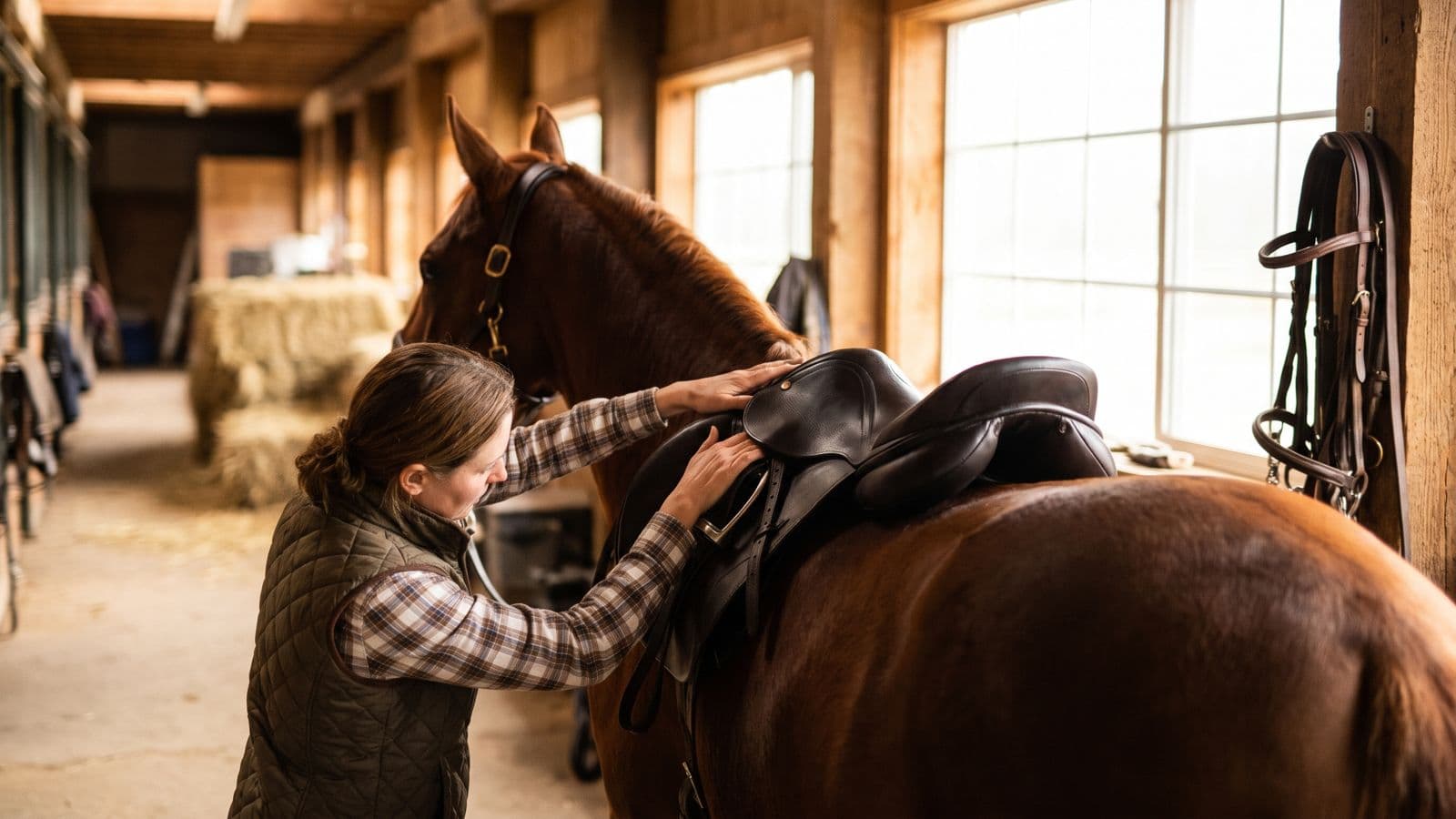
Choosing the right saddle is one of the most important decisions you'll make as a horse owner — and one of the easiest to get wrong. The right saddle does more than make riding comfortable: it protects your horse's back, supports correct movement, and helps you maintain a balanced position in the saddle.
With so many saddle designs, brands, materials and sizes on the market, it's tempting to choose based on appearance, price or a friend's recommendation. But a saddle that fits one horse beautifully can be entirely unsuitable for another. The goal is to find a saddle that fits both your horse and you, suits your riding discipline, and allows your horse to move freely without discomfort.
Research published in equine veterinary journals shows that poor saddle fit can contribute to back pain, restricted movement and reduced performance. Leading equestrian welfare organisations also emphasise that saddle fit isn't permanent — changes in a horse's weight, fitness and muscle development can alter how a saddle fits over time.
So, how do you choose the right one?
Start With Your Riding Discipline
Before looking at brands or sizes, consider what you intend to do with your horse. Different disciplines require different saddle designs because the rider's position, movement and balance requirements vary.
Dressage saddles
Dressage saddles are designed to support a relatively upright riding position, with a long leg and close contact with the horse. They typically feature a deeper seat, longer flaps and knee support that helps the rider maintain a consistent position while performing precise movements.
Best suited for: Dressage training and competitions. What to consider: The saddle should allow your leg to hang naturally without forcing your knee or thigh into an uncomfortable position.
Jumping saddles
Jumping saddles generally have a flatter or more open seat and forward-cut flaps, allowing the rider to shorten their stirrups and move into a forward position over fences. Knee and thigh support can help the rider maintain stability while jumping.
Best suited for: Show jumping, eventing and other jumping activities. What to consider: The saddle should allow sufficient freedom for the rider to move with the horse rather than restricting their position during take-off and landing.
All-purpose saddles
All-purpose saddles offer a compromise between dressage and jumping designs. They can be useful for riders who participate in general schooling, hacking and occasional jumping without specialising in a single discipline.
Best suited for: Recreational riders, general-purpose riding and varied activities. What to consider: An all-purpose saddle offers versatility, but it may not provide the specialised support required for serious dressage or competitive jumping.
Western saddles
Western saddles have a different construction from English saddles. They typically feature a horn, a larger seat and a broader weight-bearing structure. Different Western saddle designs are intended for activities such as trail riding, reining, roping and ranch work.
Best suited for: Western riding disciplines and trail riding, depending on the design. What to consider: Saddle weight, tree shape, rigging and the intended activity all influence suitability.
Endurance saddles
Endurance saddles are designed for extended periods in the saddle. They aim to provide comfort, stability and appropriate weight distribution over long distances.
Best suited for: Endurance riding and long-distance trail riding. What to consider: Weight, ventilation, rider comfort and the saddle's ability to remain stable throughout prolonged exercise.
The takeaway: Choose a saddle designed for your primary riding discipline. A versatile saddle can be a sensible choice for general riding, but no design should be selected at the expense of fit.
Understand Your Horse's Shape Before Choosing a Saddle
This is arguably the most important part of the process. Horses vary considerably in their physical structure — two horses of the same breed, height and approximate weight may need completely different saddles. Important factors include the horse's withers, shoulder shape, back length, rib-cage shape and muscle development.
Wither height and shape
The withers are the raised area between the neck and the back. Some horses have high, prominent withers, while others have flatter, broader withers. A saddle that is too narrow or otherwise incorrectly shaped may press against the withers; one that's too wide may sit too low at the front, potentially causing pressure in the same area. There must be appropriate clearance between the saddle and the withers, including when the rider is mounted.
Do not assume that adding a thicker saddle pad will correct inadequate clearance — padding can sometimes make an already tight fit worse.
Shoulder shape and movement
Your horse's shoulders must be able to move freely during exercise. A saddle positioned too far forward or with an unsuitable tree shape can interfere with the movement of the shoulder blades, affecting stride and comfort, particularly during activities requiring substantial forelimb movement such as jumping. A saddle must accommodate not just the horse's standing shape but also its movement.
Back length
The saddle's weight-bearing area must fit within the appropriate region of the horse's back. A saddle that is too long may place pressure beyond the suitable weight-bearing area, particularly towards the sensitive lumbar region — especially important for horses with short backs. A larger horse does not automatically have a longer back suitable for a longer saddle; individual anatomy matters more than overall size.
Back curvature and muscle development
Some horses have relatively flat backs, while others have more pronounced curves. The saddle's tree and panels must accommodate the horse's back shape without creating concentrated pressure points or excessive movement. Muscle development matters too — a horse that gains fitness and develops its topline may fit a saddle differently than when it was less conditioned, and weight loss or reduced exercise can alter fit similarly.
Practical advice: Before purchasing a saddle, have your horse's back assessed by a qualified saddle fitter. This is far more reliable than selecting a saddle based solely on breed, height or measurements.
Know the Five Essential Elements of Saddle Fit
A saddle can look correct and still fit poorly. When assessing a saddle, pay attention to five key areas.
A. Tree width and shape
The tree is the structural framework that supports the saddle and helps distribute the rider's weight. Its width and shape must suit the horse's shoulder and back conformation. A tree that's too narrow can create excessive pressure in specific areas; one that's too wide may allow the saddle to sit too low at the front or distribute pressure incorrectly. The correct tree isn't determined by width alone — its overall shape and angle must also suit the horse.
B. Wither and spinal clearance
The saddle must not press against the top of the withers or the spinal processes. There should be appropriate clearance along the gullet, the channel running beneath the saddle's centre, and that clearance must remain adequate when the rider is mounted — a saddle that appears acceptable without a rider may behave differently once loaded. Excessive padding can also reduce the available channel space.
C. Even contact and pressure distribution
The saddle panels should provide reasonably even contact across the intended weight-bearing area. Concentrated pressure points can cause discomfort and may contribute to soreness or changes in muscle development. Conversely, excessive gaps or "bridging" — where the saddle contacts the back mainly at the front and rear while leaving a gap through the middle — can also create uneven loading.
D. Stability
A correctly fitted saddle should remain reasonably stable during movement. Watch for excessive rocking, sliding forwards or backwards, or repeatedly shifting to one side. Do not attempt to solve persistent slipping simply by tightening the girth excessively — investigate the underlying cause instead.
E. Freedom of movement
The saddle should allow the horse to move naturally — it should not interfere with the shoulders, restrict the back unnecessarily, or force the rider into a position that compromises balance. A saddle that seems comfortable while the horse stands still may reveal problems once the horse walks, trots, canters or performs its normal work.
Research published in Equine Veterinary Education identifies inappropriate tree width, interference with the shoulder blades and inadequate wither clearance among the most important saddle-fitting concerns. The principle is straightforward: a saddle must fit the horse in motion, not just when standing in the stable.
Remember That the Saddle Must Fit the Rider Too
Saddle selection isn't just about the horse. The rider's body proportions, flexibility, leg length and preferred riding position all influence which saddle will work best. A saddle that fits the horse but forces the rider into an unbalanced position isn't a good solution.
Consider the following:
- Seat size: You should have sufficient room to sit comfortably without feeling cramped or sliding around.
- Seat shape: A deep, restrictive seat may suit some riders and disciplines but feel uncomfortable or limiting to others.
- Flap length and angle: These should accommodate your leg length and natural riding position.
- Knee and thigh support: Support should help stabilise you without forcing your leg into an unnatural position.
- Balance: You should be able to sit in a balanced position without constantly fighting the saddle.
Seat-size labels aren't perfectly standardised across manufacturers — a particular seat size in one saddle may feel different in another. Your body proportions matter too: two riders of similar height may need different saddle designs because their leg lengths, pelvis shapes and preferred positions differ.
When trying a saddle, assess it while mounted, ideally under the supervision of a qualified fitter or experienced coach. Your comfort matters, but so does the effect your position has on the horse — an unstable or poorly balanced rider can create uneven loading even when the saddle itself appears suitable.
Choose the Right Saddle Material
Saddles are available in leather and synthetic materials, each with advantages and limitations.
Leather saddles
Leather saddles are valued for their durability, traditional appearance and ability to develop a personalised feel with use. Depending on design and quality, they can offer excellent support and longevity. However, leather requires regular cleaning, conditioning and appropriate storage, and may be heavier or more expensive than some synthetic alternatives.
Synthetic saddles
Synthetic saddles are often lighter and easier to clean. They can be practical for everyday riding, beginners and riders who want relatively low-maintenance equipment. Their durability and feel vary according to the materials and construction used, and some models offer fitting systems that allow adjustments within specified limits.
Which should you choose? Neither material is automatically better for your horse. A well-fitted synthetic saddle is preferable to an expensive leather saddle that creates pressure points. Similarly, a good-quality leather saddle is an excellent choice when it fits both horse and rider. Prioritise fit, construction, condition and suitability for your discipline before considering material or appearance.
Should You Buy a New or Second-Hand Saddle?
Buying a saddle is a significant investment, but the highest price doesn't guarantee the best fit. Both new and second-hand saddles can be good options.
Buying a new saddle
Advantages include access to current designs and fitting systems, the ability to select particular seat sizes and specifications, potential manufacturer warranties, and a known ownership and maintenance history. The main disadvantages are cost and the possibility that your horse's shape may change after purchase. A new saddle should still be fitted professionally — being new doesn't make it suitable for every horse.
Buying a second-hand saddle
A second-hand saddle can offer excellent value, particularly if you find a model that fits your horse and rider well. However, inspect it carefully for:
- Damage or distortion to the tree.
- Uneven, compressed or damaged panels.
- Worn stitching, billets and girth straps.
- Damaged stirrup bars or other safety-critical components.
- Signs of previous repairs or structural alterations.
- Evidence of poor storage or inadequate maintenance.
A saddle that looks attractive and is being sold at a substantial discount may still be unsuitable. Before buying, arrange a fitting assessment and, where possible, a trial period with clear return terms. Don't buy a saddle simply because it fitted the previous owner's horse — your horse's anatomy may be completely different.
How to Test a Saddle Before Buying It
Never rely entirely on photographs, a manufacturer's size chart or a quick inspection while the horse is standing. A proper assessment should consider the horse, the saddle and the rider together.
Step 1: Assess the saddle without a pad
Place the saddle on the horse's back in the appropriate position, following the fitter's guidance. Check that it sits appropriately, has suitable wither clearance and does not interfere with the shoulder blades. Look at the saddle from the side and behind to identify obvious imbalance or asymmetry. This is an initial assessment, not proof that the saddle fits.
Step 2: Check the saddle's contact and balance
Examine the saddle's position and panel contact. It should not tilt excessively forwards or backwards, rock noticeably, or create obvious gaps or concentrated contact points. The fitter should also check whether the tree shape and panel design are suitable for the horse.
Step 3: Repeat the assessment with the rider mounted
The rider's weight changes how the saddle interacts with the horse's back. Check that appropriate clearance remains, the saddle stays reasonably stable, and the rider can maintain a balanced position. This stage is essential — a saddle may appear suitable when unloaded but perform differently under a rider.
Step 4: Ride the horse
If the initial checks are satisfactory, ride at the horse's normal working paces and, where appropriate, perform movements relevant to the intended discipline. Observe whether the saddle remains stable and whether the horse moves comfortably. Pay attention to changes in stride, reluctance to move forward, unusual behaviour or difficulty performing familiar movements.
Step 5: Assess the horse after exercise
After removing the saddle, check the back for soreness, swelling, rubbing or unusual hair wear. Sweat patterns can provide useful information, but they must be interpreted carefully — dry spots alone don't prove poor fit, just as uniform sweating doesn't prove good fit.
Step 6: Agree on a follow-up plan
Before completing the purchase, ask whether the saddle can be adjusted as the horse's condition changes, what maintenance or refitting may be needed, and whether the fitter offers follow-up assessments. This is particularly important for young horses, horses returning to work, and animals undergoing substantial changes in fitness or weight.
Warning Signs That Your Saddle May Not Fit Properly
Horses cannot explain discomfort in words, so owners must pay attention to physical and behavioural changes.
During tacking up: pinning the ears, moving away or becoming unusually defensive; repeatedly swishing the tail or showing discomfort when the saddle is placed on the back; reacting negatively to girthing.
During riding: unusual resistance or reluctance to move forward; difficulty maintaining a familiar gait or performing established movements; repeatedly hollowing the back, resisting contact or showing other changes in behaviour; a saddle that consistently slips, rocks or shifts to one side.
After riding: localised soreness, swelling or rubbed areas; abnormal hair wear or broken hairs; changes in the topline or visible muscle asymmetry; sensitivity when the back is touched.
These signs aren't proof the saddle is responsible — dental problems, lameness, training issues and other medical conditions can produce similar symptoms. If your horse develops persistent discomfort, consult a veterinarian and arrange a professional saddle assessment. Don't assume that changing the saddle alone will resolve the problem.
How Often Should You Have Your Saddle Checked?
One common mistake is assuming that a saddle which fitted correctly last year must still fit today. Horses change shape in response to weight gain or loss, changes in fitness and muscle development, age and growth, pregnancy where relevant, changes in workload or training, and recovery from injury or periods of reduced exercise.
The British Horse Society recommends having saddle fit checked at least twice a year by an appropriately qualified saddle fitter.
This is a useful general guideline, but it shouldn't replace additional checks when your horse's shape, workload or behaviour changes. A growing horse or one undergoing substantial conditioning may require more frequent assessments.
Common Saddle-Buying Mistakes to Avoid
Even experienced riders can make mistakes when choosing a saddle.
- Choosing a saddle because of its brand. A prestigious brand doesn't guarantee a suitable fit — evaluate the actual saddle on your horse.
- Assuming one saddle will fit every horse. Horses differ in back shape, shoulder structure and muscle development.
- Buying based on appearance. A beautiful saddle is of little value if it compromises comfort or movement.
- Using thicker pads to fix every fitting problem. Padding can help with specific, professionally assessed issues, but it cannot reliably correct an unsuitable tree shape, excessive length or every form of poor contact.
- Ignoring rider fit. A saddle that's comfortable for your horse but leaves you unbalanced may still create problems for both of you.
- Ignoring changes in the horse's body. Reassess fit when your horse's shape changes — don't wait for obvious soreness.
- Buying without a proper trial. Whenever possible, have the saddle assessed and trialled before committing.
Should You Use a Professional Saddle Fitter?
Yes. Professional saddle fitting is one of the most useful investments you can make in your horse's comfort and long-term wellbeing. A qualified fitter can evaluate the saddle's tree, panel contact, balance and stability, assess the rider's position, and determine whether adjustments are appropriate. For a more complete assessment, choose someone who evaluates the saddle both without and with a rider and, where practical, observes the horse in motion.
If your horse has persistent back pain, unexplained performance problems or suspected musculoskeletal injury, involve a veterinarian — saddle fitting and veterinary assessment complement one another but aren't interchangeable. When choosing a fitter, ask about their training, experience with your discipline, assessment process and any commercial interests that may influence recommendations. The aim should be to find a suitable saddle for your horse, not simply to sell a particular brand.
A Practical Checklist Before You Buy
| What to check | What you want to establish |
|---|---|
| Riding discipline | The saddle suits your primary activity. |
| Tree width and shape | The structure accommodates your horse's conformation. |
| Wither clearance | There is appropriate clearance under load. |
| Spinal clearance | The saddle's central channel avoids inappropriate pressure on the spine. |
| Panel contact | Contact is appropriately distributed without problematic gaps or pressure points. |
| Saddle length | The weight-bearing area suits your horse's back. |
| Shoulder movement | The saddle does not unnecessarily restrict the shoulders. |
| Stability | The saddle remains reasonably stable during exercise. |
| Rider fit | You can sit comfortably and maintain a balanced position. |
| Condition | The tree and safety-critical components are sound. |
| Trial ride | The saddle performs appropriately during the horse's normal work. |
| Professional assessment | A qualified fitter has assessed the horse-and-rider combination. |
| Follow-up | You have a plan for reassessment as the horse changes shape. |
If a saddle fails an important fit or safety check, don't proceed simply because it's inexpensive or looks right.
Final Thoughts: The Best Saddle Is the One That Works for Your Horse
Choosing the right saddle requires more than measuring your horse or selecting a familiar brand. The ideal saddle should suit your riding discipline, accommodate your horse's individual conformation, distribute weight appropriately and allow the rider to maintain a balanced position. It should also remain comfortable and stable during movement.
Start by understanding your horse's back and your own riding requirements. Shortlist appropriate saddle designs, inspect their condition, arrange a professional fitting, and test the saddle under realistic riding conditions.
Most importantly, remember that saddle fit is not a one-time decision. Your horse's body changes with age, training, weight and fitness, so the saddle should be reassessed regularly. A well-chosen saddle is an essential part of the relationship between horse, rider and performance — investing time in finding the right fit helps protect your horse's comfort, support better movement, and make riding a more enjoyable experience for both of you.